
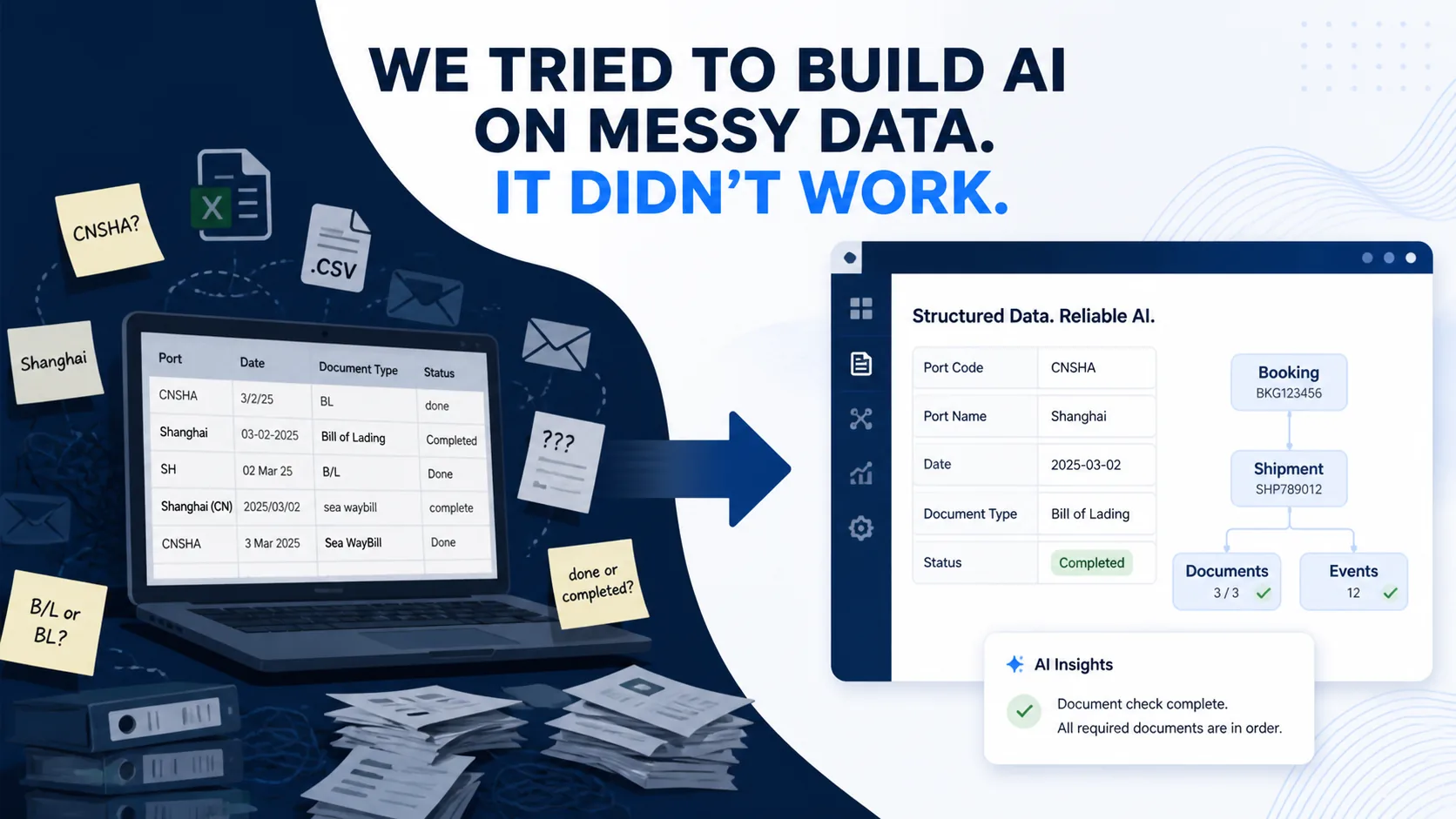
We Didn't Start With AI. We Started With a Problem.
At one point, my team and I were pretty convinced we were ready for AI.
We had clear use cases:
- Auto-checking shipping documents
- Suggesting required documents based on booking data
- Helping ops quickly answer “why is this booking stuck?”
All very real problems. All very painful in daily operations.
So naturally, the next step felt obvious: build something “AI-powered” to solve them.
That’s where things started to break.
The First Reality Check: Our Data Was All Over the Place
On paper, we had everything:
- Booking data in the system
- Document data in shared drives
- Status updates across multiple internal tools
In reality:
- The same port showed up as
CNSHA,Shanghai, and sometimes just “SH” - Document types were free-text in some places, dropdowns in others
- Key fields like “booking status” or “exception reason” were either missing or inconsistently used
From a PM perspective, this is where I messed up.
I assumed “we have data” = “we can use AI”.
That assumption is just wrong.
What Structured Data Actually Means (The Hard Way)
I used to think structured data meant “it’s in the database”.
What I learned is — that’s not even close.
For data to be usable (not just for AI, but for anything reliable), it needs to be:
Consistent
Same concept → same format, everywhere.
Not 5 ways to represent the same port or document type.Controlled
Clear input rules. Dropdowns, validation, constraints.
Not free-text fields where ops teams improvise.Connected
Booking ↔ shipment ↔ documents ↔ events.
Not isolated records living in different systems.
Most carrier-side systems (including ours at some point) fail at least one of these.
Usually more than one.
Why Our AI Attempt Failed
We actually tried to build a document-related AI feature.
The idea was simple:
Given a booking, list required documents and pre-fill them using existing data.
Sounds straightforward.
What actually happened:
- Missing fields → AI had nothing to pre-fill
- Inconsistent naming → mapping logic kept breaking
- Document requirements not standardized → no reliable rule base
So instead of “AI making things faster”, we got:
- More edge cases
- More manual overrides
- More confusion from ops
At some point, it became obvious:
We weren’t building AI.
We were building workarounds on top of messy data.
The Uncomfortable Truth (Especially for PMs)
This is the part most teams — including mine — try to skip.
Cleaning data is:
- Not visible to stakeholders
- Hard to measure in short-term KPIs
- Painful to push onto operations teams
But without it, everything downstream becomes fragile.
Even worse: You can still ship something that looks like AI.
It demos well.
It impresses in meetings.
And then it quietly fails in real operations.
What I’d Do Differently Now
If I had to restart that initiative today, I wouldn’t start with AI at all.
I’d start with a very boring scope:
Pick 1 flow. 1 entity. 1 problem.
For example:
- Booking → required documents
Then:
- Define standard document types (no free text)
- Enforce input validation at source
- Backfill critical fields for recent data
- Make relationships explicit (booking ↔ doc requirements)
Only after that, I’d even consider adding AI on top.
Not because AI is hard —
but because bad data makes everything unpredictable.
What Actually Changes When Data Is Clean
This is the interesting part.
When you finally get structured data right (even partially):
- Simple rules already solve 50% of the problem
- AI becomes a multiplier, not a crutch
- Ops teams trust the system more
The irony is: The “AI magic” people expect usually comes from fixing fundamentals first.
Final Thought
If you're working on AI in logistics (especially on the carrier side), ask this before anything else:
“If I remove AI completely, does my data still make sense?”
If the answer is no —
adding AI won’t fix it.
It will just make the problem harder to see.