
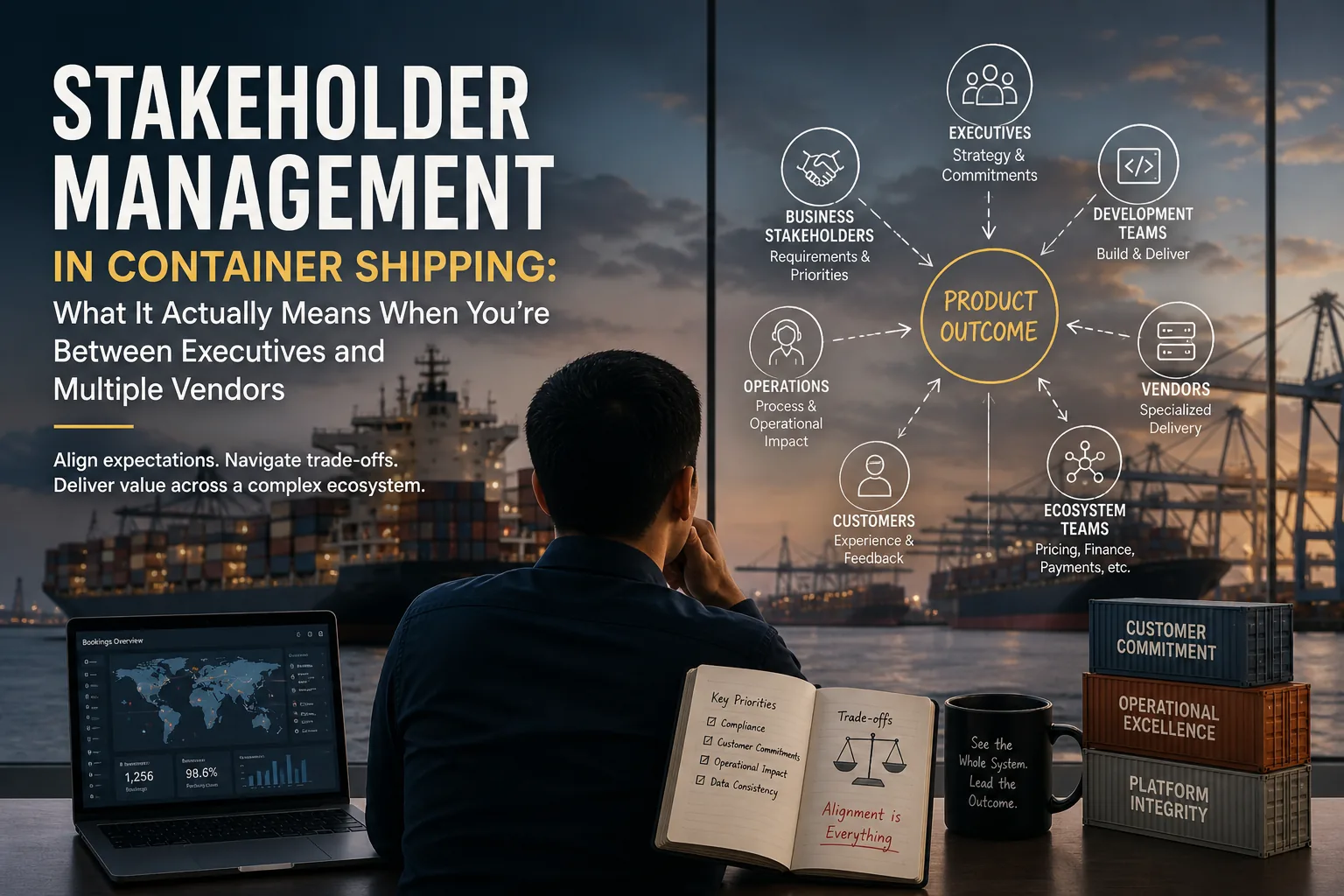
Most stakeholder management advice sounds like this:
- Communicate clearly
- Keep stakeholders informed
- Align expectations
That works — until you step into a real container shipping environment.
Because here, you're not managing “stakeholders.”
You're balancing:
- Executives committing features to customers
- Multiple vendors building different parts of the system
- Operations teams carrying the operational risk
- Internal teams working on parallel products in the same ecosystem
At that point, stakeholder management stops being a communication exercise.
It becomes how you keep a fragmented system from falling apart.
Why Stakeholder Management Actually Matters
At a high level, the idea is simple:
The people who have the most impact on your product
will also determine whether your product succeeds or fails.
But in practice, it’s not about “maintaining good relationships.”
It’s about:
- Understanding what each group really wants
- Managing what they expect will happen
- And making sure those expectations don’t silently conflict
If you don’t do this well:
- Executives overcommit
- Vendors under-deliver
- Operations absorbs the gap
And you only realize it when things break.
A Mistake I Made (That Looked Small — Until It Wasn’t)
At one point, I was acting as a Platform Product Owner, overseeing multiple booking flows on the same platform.
We had a new regulation set applied to Contract Booking — required updates in validation rules, data structure, and compliance handling.
The assumption I made:
“This only affects Contract Booking.”
So we:
- Delivered the change within that flow
- Aligned with the responsible vendor
- Got business sign-off
And moved on.
What I didn’t fully account for:
Spot Booking was running on a separate logic path — but sharing the same platform-level data model.
No one explicitly raised it:
- Vendors focused on their scoped delivery
- Business focused on the Contract flow
- No one owned the cross-flow consistency
Result:
- Contract bookings followed the new regulation
- Spot bookings continued using the old logic
- Data became inconsistent across booking types
From a system perspective:
→ Same platform
→ Same customer
→ Same shipment context
But: → Different rules applied depending on booking type
It didn’t break immediately.
But when it surfaced:
- Operations had to manually reconcile differences
- Business started questioning data reliability
- And we had to fix it after release, across multiple vendors
What Actually Went Wrong
It wasn’t a technical issue.
It was a stakeholder management failure.
Specifically:
- I scoped the problem at feature level, not platform level
- I aligned with direct stakeholders, not the full ecosystem
- I didn’t validate shared data impact across flows
In short:
I managed stakeholders within a boundary
instead of managing the system as a whole
Who You’re Actually Managing (Not Just “Stakeholders”)
In theory, stakeholders are just roles.
In reality, they are different sources of pressure.
Your Core Delivery Layer
- Developers
- UI/UX Designers
- Scrum Master / Delivery Manager
- Technical Architect
- Product Owners / Domain Product Leads
The Vendor Layer (Where Most Problems Hide)
- Frontend vendor
- Backend/API vendor
- Infrastructure/platform vendor
- Business integration / EDI vendor
Each vendor:
- Optimizes for their scope
- Has limited visibility into the full product
- Will not naturally take responsibility outside their boundary
Your system doesn’t break inside a vendor.
It breaks between vendors.
The Business Layer
- Regional business stakeholders
- Commercial / sales teams
- Senior leadership / executives
The Ecosystem Layer
- Pricing team
- Finance team
- Payment systems
- Other internal platforms
This is where my mistake lived.
Because the issue wasn’t inside one feature.
It was across the ecosystem.
The Reality: You Don’t Control Delivery
As a PM in this setup:
- You don’t control vendor capacity
- You don’t control executive commitments
- You don’t control all dependencies
So what do you actually control?
You control alignment and expectations
And more importantly:
You define where alignment needs to happen
Miss that — and no one else will catch it.
What “Managing Stakeholders” Actually Looks Like
1. Put Yourself in Their Shoes (But Don’t Stop There)
Ask:
- Why are they pushing?
- What risk are they trying to avoid?
But also ask:
“Who is not in this conversation that should be?”
That’s where problems hide.
2. Decide What You Need From Each Stakeholder
Not everyone needs the same level of involvement.
But for platform-level changes:
If you treat it like a feature-level change
→ You will miss cross-impact
3. Manage Expectations — Across Boundaries
Not just:
- Business expectation
- Vendor expectation
But also:
System expectation
Example:
- “If Contract Booking changes, what happens to Spot Booking?”
- “If validation rules change, who else consumes this data?”
If you don’t ask this: → You create silent inconsistencies
4. Document Decisions — Especially Assumptions
The most dangerous thing is not wrong decisions.
It’s unwritten assumptions.
In my case:
- “This only affects Contract Booking”
→ was never challenged
→ because it was never explicitly documented
5. Cross-Team Awareness Is Not Optional
This is where the real work is.
You need to constantly check:
- What other teams are building
- What logic they rely on
- What shared components exist
Because no one else sees the full system.
The Hard Part: Trade-Off Orchestration
At some point, everything becomes a trade-off:
- Speed vs completeness
- Business commitment vs system consistency
- Vendor delivery vs platform integrity
Your job is to surface it clearly:
“We can deliver Contract Booking now,
but Spot Booking will be inconsistent.
Or we align both flows and delay release.”
That decision should not happen after production.
Final Thought
Stakeholder management is not about being friendly.
It’s not about sending updates.
It’s about:
- Seeing the system beyond your immediate scope
- Making hidden dependencies visible
- And forcing alignment before things break
Because in container shipping systems:
You are not managing stakeholders.
You are holding together a system where no one owns the full picture.