The Problem Doesn’t Start at the Customer Side
When we talk about shipment visibility, the conversation usually focuses on customers:
- Why can’t shippers track their cargo?
- Why do they still need to ask for updates?
But if you look inside a carrier’s operation, the gap often starts earlier — internally.
Most of the time, things work fine.
Shipments move, updates flow, teams coordinate.
But occasionally, when something changes mid-flow, you start to see the cracks:
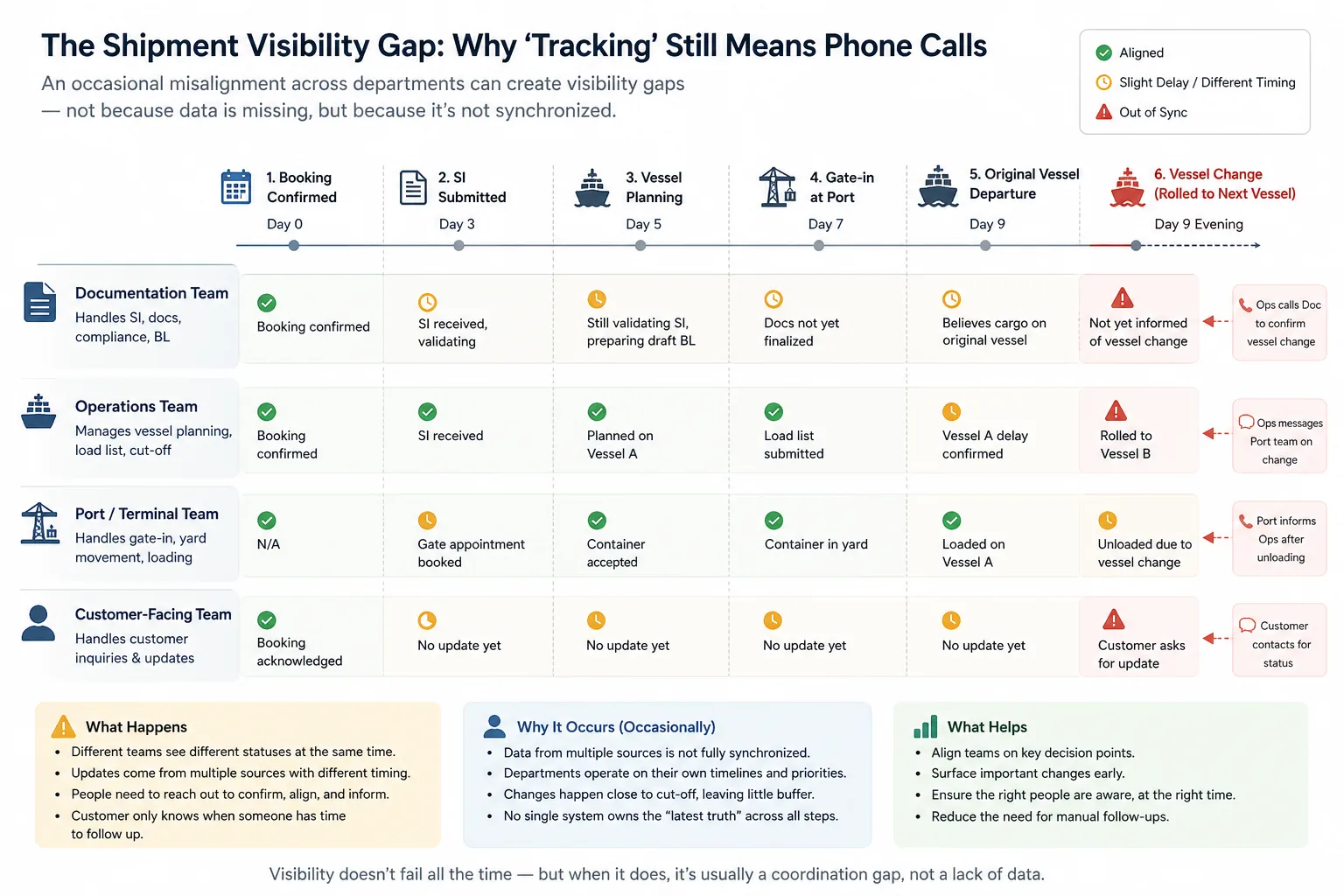
- Documentation team sees one status
- Operations sees another
- Port side already moved ahead
And it takes a few messages on Google Chat or a quick call to align everyone again.
A Scenario That Feels Familiar
Take a typical export shipment:
- Booking is confirmed
- SI comes in close to cutoff
- Documentation is still validating
- Operations proceeds with vessel planning
Then a change happens:
- The container doesn’t make the intended vessel
At that point:
- Port or ops may know first
- Documentation may still be processing based on original plan
- Customer is not yet informed
No major failure — but not fully aligned either.
So what happens next?
Someone checks with another team.
A quick message is sent.
A call is made to confirm.
It’s not chaos — just friction.
Where the Misalignment Comes From
This is not about systems “not working.”
It’s about how different parts of the operation move at slightly different speeds.
1. Each Team Operates on Its Own Timeline
Documentation focuses on:
- SI validation
- Draft BL
- Compliance
Operations focuses on:
- Vessel planning
- Load readiness
- Cutoff management
Port focuses on:
- Gate-in
- Yard handling
- Actual loading
These are all valid — but they don’t always update in sync.
2. Data Comes From Multiple Sources — Not Fully Synchronized
Behind the scenes, updates are coming from:
- Internal documentation systems
- Operations planning tools
- Terminal or port systems
- External message feeds
Each source updates differently:
- Some are near real-time
- Some are batch-based
- Some depend on manual input
So during certain moments:
You may have multiple “latest statuses” depending on where you look.
Most of the time, this is manageable.
But during changes, it becomes visible.
3. Alignment Still Relies on People
When systems don’t fully align, teams fall back on simple coordination:
- “Can you confirm if this container is loaded?”
- “Has SI been finalized?”
- “Is the vessel still the same?”
These are usually resolved quickly.
But they highlight something important:
The system provides information —
but people still connect the dots.
Why More “Tracking” Doesn’t Fully Solve It
A common reaction is:
- Add more visibility
- Integrate more data
- Build better dashboards
These help — but only to a point.
Because the issue is not only seeing more.
It’s about:
- Seeing the same thing
- At the same time
- Across all teams
Without that alignment, additional tracking can sometimes just surface more differences.
What Helps in Practice
From what I’ve seen, small adjustments make a bigger difference than large platforms.
1. Agree on Key Decision Points
Instead of trying to align everything, focus on moments that matter:
- Before vessel cutoff
- After SI approval
- When vessel assignment changes
At these points, teams need to be aligned — even if upstream data isn’t perfect.
2. Highlight Changes, Not Just Status
Rather than showing full timelines, emphasize:
- What changed
- What might impact downstream steps
For example:
- “Container rolled to next vessel”
- “SI pending close to cutoff”
This makes coordination faster.
3. Let Updates Trigger Awareness
When something important changes, the right people should know early:
- Ops sees documentation delays
- Documentation sees vessel changes
- Customer-facing teams see potential impact
Not to replace communication — but to reduce the need for reactive follow-ups.
Final Thought
Shipment visibility doesn’t break all the time.
But when it does, it usually comes down to this:
Different teams are working with slightly different versions of the same shipment.
Most of the time, coordination fills the gap.
But improving how systems align — even just at key moments —
can reduce the need for those extra messages and calls.