
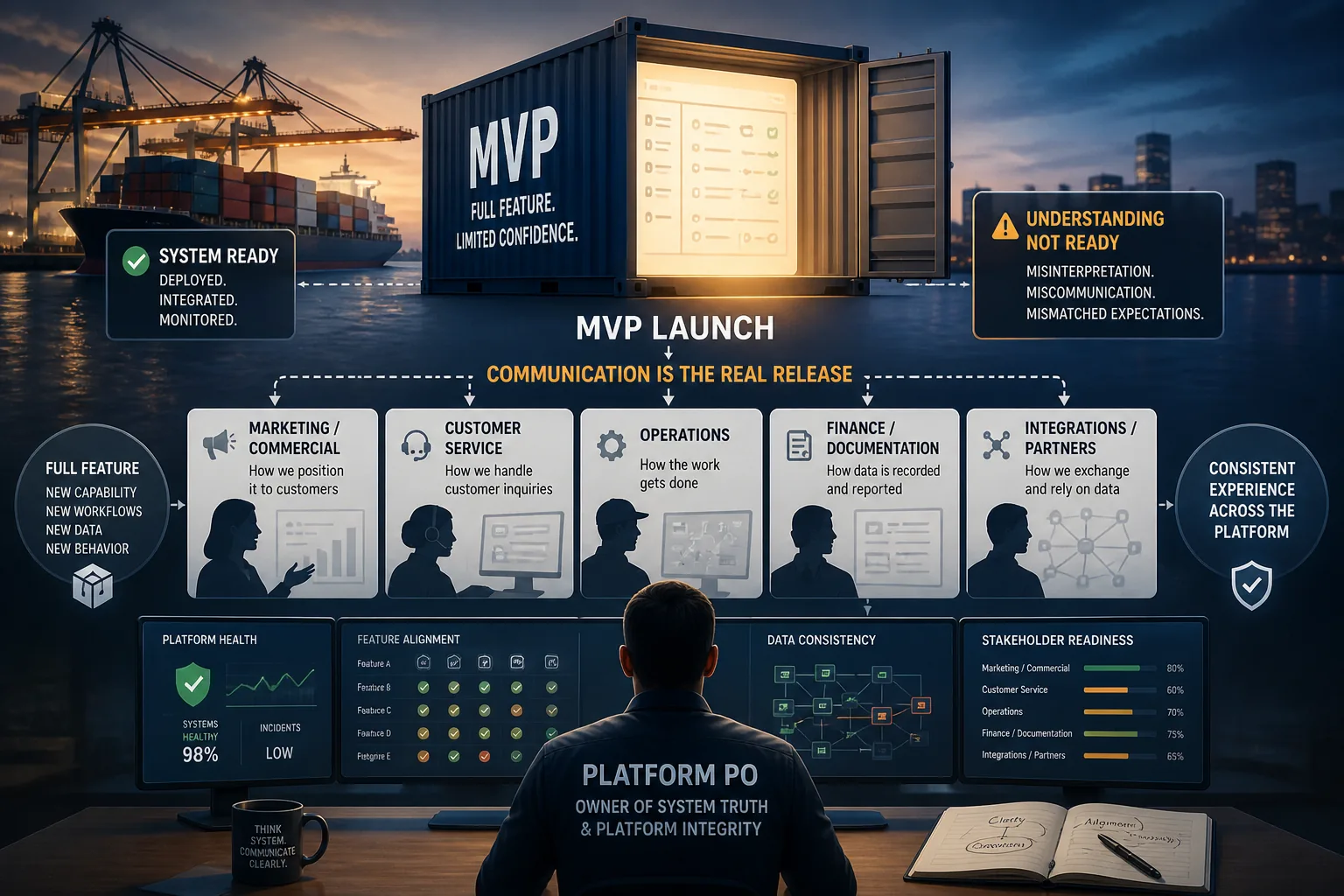
The Dangerous Lie: “It’s Just an MVP”
In most tech discussions, MVP means:
a smaller version of a feature
In enterprise container shipping platforms, that’s not what actually happens.
What we call an MVP is usually:
a complete feature shipped under controlled confidence
UI is there. Flows are there. Integration is there.
To most stakeholders, it looks… done.
And that’s the problem.
Because while the feature looks complete, understanding across the organization is not.
Early Days as a Feature PO: I Underestimated the Broadcast
When I first launched MVP features as a Feature Product Owner, I focused on:
- delivering full functional flows
- aligning with engineering and QA
- ensuring safe deployment
What I underestimated was this:
Launching an MVP is not about building the feature.
It is about broadcasting the feature across the organization.
And the scale of that broadcast is massive.
Because in a logistics platform, a “feature” touches:
- booking operations
- documentation teams
- customer service
- commercial / sales teams
- sometimes even external partners
I treated MVP communication like a release note.
Reality: it should have been treated like a cross-organization rollout plan.
Where Things Actually Break: Human Interpretation Gaps
The system doesn’t fail first.
People do.
1. Marketing / Commercial Teams
They hear:
“New feature is live”
They tell customers:
“You can now use this new capability”
But they don’t know:
- edge cases
- limitations
- unstable scenarios
- what not to promise
So customers come in with expectations the system can’t consistently meet.
2. Customer Service Teams
They are the first line of impact.
Customers ask:
- “Why is my booking stuck?”
- “Why is this status different from before?”
- “Why does this flow behave differently?”
And support teams often:
- don’t have the context
- don’t know it’s MVP behavior
- don’t know the workaround
So they escalate.
Or worse — they give inconsistent answers.
3. Operations Teams
Ops teams don’t care about MVP.
They care about:
- getting the booking through
- meeting cut-off time
- avoiding manual rework
If the system behaves slightly differently:
- they create workarounds
- they bypass flows
- they lose trust
And once ops loses trust, your feature adoption is already dead.
The Core Problem: Full Feature, Partial Truth
What you are really shipping is:
A fully visible feature with a partially stable truth model
That creates:
- inconsistent behaviors across flows
- edge cases not handled uniformly
- data that looks valid but behaves differently
And unless this is clearly communicated:
Everyone assumes:
“This is how the system works now”
Even when it isn’t.
Moving to Platform PO: This Is No Longer a Feature Problem
At Feature PO level, the challenge is:
“Did I explain my feature clearly?”
At Platform PO level, the question becomes:
“Does the entire platform still behave coherently after this release?”
This is where most organizations underestimate the role.
Platform PO is not:
- a coordinator
- a meeting facilitator
- a release tracker
Platform PO is:
the owner of system truth and behavioral consistency
The Real Responsibility of a Platform PO
1. Protecting Platform Integrity
You need to ensure:
- no conflicting logic across features
- no multiple “truths” for the same data
- no broken assumptions between modules
Because once inconsistency leaks:
- reporting breaks
- integrations misbehave
- users lose trust
2. Governing Cross-Feature Behavior
Each Feature PO optimizes for their feature.
Someone needs to ask:
- what happens when all these features run together?
- are we introducing competing interpretations?
This is not optional.
Without this layer, MVPs accumulate into chaos.
3. Owning Cross-Department Communication
At platform level, communication is no longer internal.
You must ensure alignment across:
- operations
- customer service
- commercial teams
- external stakeholders (if applicable)
And not just awareness.
But correct interpretation.
MVP Launch = Communication Architecture
At this point, MVP launch stops being:
- a deployment event
- a checklist exercise
It becomes:
a communication architecture problem
You are designing:
- what each team understands
- what they tell customers
- how they react when things don’t behave perfectly
If this architecture is weak:
- incidents increase
- escalations spike
- trust drops
Even if your system is technically fine.
What I’d Do Differently Today
As a Feature PO:
- Treat MVP as a full product with limited guarantees
- Write explicitly:
- what is unstable
- what is inconsistent
- what should NOT be promised to customers
- Align with support and ops before release, not after
As a Platform PO:
- Actively validate platform-wide behavior consistency
- Block releases that introduce conflicting logic (even if feature-level is “ready”)
- Own a single source of truth for how the system behaves today
- Treat communication as a first-class release deliverable
Final Thought
In logistics platforms, failures don’t always show up as system outages.
They show up as:
- confused customers
- inconsistent answers
- operational workarounds
- silent loss of trust
And those are much harder to detect — and much harder to fix.
If your MVP looks complete, but your organization doesn’t fully understand it…
Then it’s not an MVP problem.
It’s a communication failure waiting to happen.