
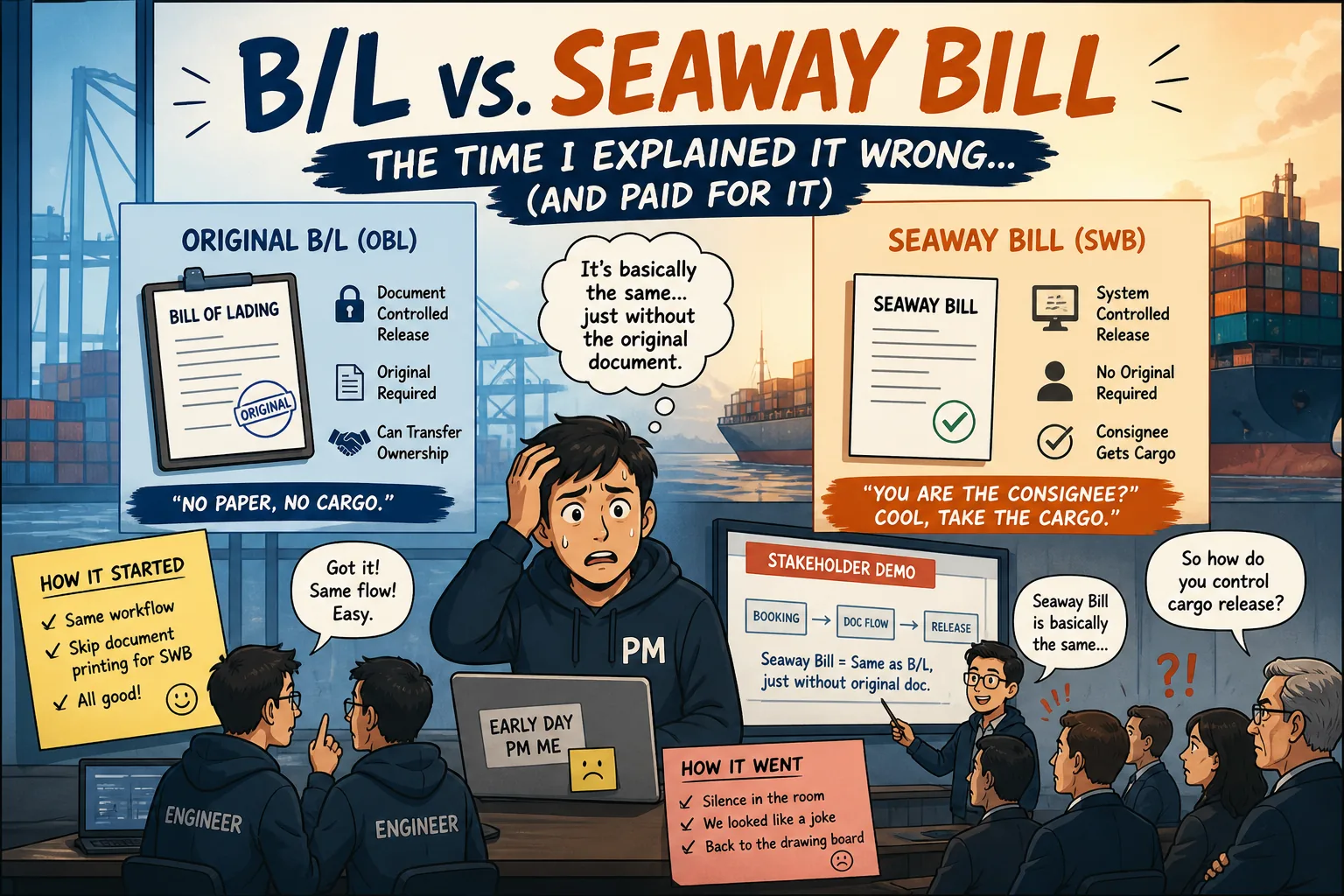
Let Me Start With a Mistake
Early in my PM days in container shipping, I thought I understood B/L vs. Seaway Bill.
Not deeply.
Just enough to sound confident.
Which, as it turns out, is the most dangerous level of understanding.
The Setup
We were building a booking and documentation flow.
At some point, the question came up:
“What’s the difference between Original B/L and Seaway Bill?”
I gave what I thought was a perfectly reasonable answer:
- B/L → more formal, needs document
- Seaway Bill → faster, digital version
The team nodded.
Engineers translated that into:
“Okay, same workflow — just skip document printing for Seaway Bill.”
I didn’t correct them.
That was mistake number one.
The Demo
A few weeks later, we had a stakeholder demo.
Audience:
- Ops leads
- Documentation experts
- People who have been doing this for 10–20 years
One of the engineers walked through the flow and explained:
“Seaway Bill is basically the same as B/L, just without the original document.”
I remember that exact moment.
That half-second pause in the room.
Then someone asked:
“So how do you control cargo release?”
And that’s when everything collapsed.
What I Got Completely Wrong
I treated B/L vs. Seaway Bill as a document difference.
It’s not.
It’s a control mechanism difference.
OBL vs. SWB in a Nutshell (The Version I Wish I Knew)
🧾 Original B/L (OBL)
“No paper, no cargo.”
- Physical document = control key
- Cargo released only when original is surrendered
- Ownership can transfer via endorsement
This is:
document-controlled release
⚡ Seaway Bill (SWB)
“System says you’re the consignee? You get the cargo.”
- No original required
- No surrender process
- Release based on system + identity
This is:
system-controlled release
Why My Explanation Broke the System Design
Because once you misunderstand this, everything downstream is wrong.
What we built (based on my explanation):
- Same booking flow
- Same documentation flow
- Same release assumptions
- Just “skip document” for Seaway Bill
What we should have built:
- Two different control paths
- Different validation logic
- Different release conditions
- Different exception handling
Instead, we created a system that:
looked correct in UI
but made no sense operationally
The Real Lesson (That Took Me a While to Accept)
In shipping systems, a lot of fields are not “data.”
They are:
decisions that reshape the workflow
B/L type is one of them.
If you treat it like a dropdown, you’ve already lost.
The Question You Should Actually Ask
Not:
“Which document is faster?”
But:
“Where does control live?”
- If control lives in paper → B/L
- If control lives in system → Seaway Bill
And the uncomfortable follow-up:
“Is our system good enough to replace paper?”
Why People Still Default to B/L
Even when they don’t need it.
Because B/L is:
- slower
- more painful
- but feels safer
Seaway Bill requires:
- clean data
- trust in system
- confidence in process
And most systems don’t fully earn that trust.
The Edge Case That Will Still Mess With You
Even if you get everything right…
You’ll still hear:
“Customer wants B/L.”
Not because it’s needed.
But because:
- internal habits
- compliance expectations
- local practices
Your clean logic will meet messy reality.
Design for that.
What I’d Do Differently Now
If I could go back:
- I wouldn’t explain B/L vs. Seaway Bill as documents
- I’d explain them as control systems
- I’d force the team to model different workflows early
- I’d tie the choice to business context (L/C, ownership, trust)
Because the real failure wasn’t the demo.
It was:
building a system on top of a misunderstanding —
and only realizing it when experts called it out in real time.